
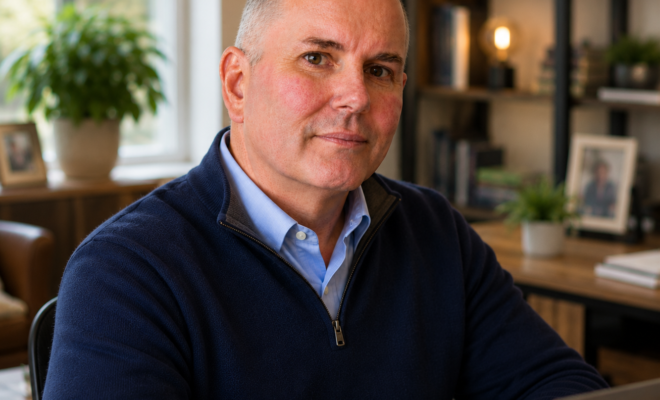
Visibility Without Exhibitionism: Being Proud of Who You Are Without Having to Show Everything
By William Smith
_____________________________________________________________________________________
I’ve spent a lot of my life thinking about what it means to be visible as a gay man. As I’ve gotten older, I’ve realized that being comfortable with who I am doesn’t necessarily mean wanting to share every part of myself with the world.
Some people are much more openly expressive about their sexuality, and I respect that. For me, however, there is something meaningful about being visible while still maintaining a private life.
This is simply my perspective—and perhaps one that other gay men over 40 will recognize in themselves.
________________________________________________________________________________________
There is a difference between being visible and putting everything on display.
As gay men, many of us have spent years thinking about visibility. We remember times when being openly gay could feel risky, complicated, or even frightening. We may have spent part of our lives deciding when to come out, who to tell, and how much of ourselves we could safely reveal.
But as we get older, something interesting can happen.
We may become more comfortable being gay while becoming less interested in showing the world everything about ourselves.
And there is nothing contradictory about that.
Being visible doesn’t mean being exhibitionistic
Being visible can be as simple as living honestly.
It might mean mentioning your partner when someone asks what you did over the weekend. It might mean having a photograph on your desk, holding hands with someone you love, attending a gay event, supporting another gay man, or simply refusing to pretend that your life is something it isn’t.
None of that requires you to reveal your sex life, your dating history, your private thoughts, or every detail of your relationships.
You can be openly gay and still be a private person.
At the same time, there is absolutely nothing wrong with someone who does enjoy being more expressive, open, provocative, or public about their sexuality. Some people are naturally that way. Some enjoy social media, Pride, nightlife, fashion, sexual expression, or simply being very open about their lives.
That’s their choice—and that’s okay.
It just isn’t necessarily my way.
I don’t think we need to turn that difference into a judgment about who is more authentic, more confident, or more “gay.”
We simply have different personalities and different comfort levels.
We don’t all have to express ourselves the same way
One of the wonderful things about getting older can be realizing that there isn’t one correct way to be a gay man.
Some men are outgoing.
Some are quiet.
Some love Pride celebrations and large social events.
Others would rather have dinner with a few close friends.
Some are comfortable talking openly about sex and relationships.
Others consider those subjects deeply personal.
Some put their lives on social media.
Others rarely post anything at all.
None of those choices automatically makes someone more or less secure in who they are.
For me, there is something appealing about being able to say, “Yes, I’m gay. It’s an important part of my life. But you don’t get access to every part of me.”
That’s not shame.
That’s a boundary.
We don’t owe everyone access to us
Modern life can sometimes make privacy seem almost old-fashioned.
Social media encourages us to share where we are, who we’re with, what we look like, what we’re doing, and sometimes even intimate details of our relationships.
There can be an unspoken expectation that visibility requires constant disclosure.
But it doesn’t.
There is a difference between hiding and choosing privacy.
Hiding can come from fear or shame.
Privacy can come from confidence.
A person who is ashamed may think, “I don’t want anyone to know this about me.”
A private person may think, “I’m comfortable with this part of myself, but I don’t need everyone to know it.”
Those are very different things.
Aging can change the way we see sexuality
For many gay men, sexuality feels different at 40, 50, 60 and beyond than it did at 20.
When we’re younger, there can be tremendous pressure to figure out who we are, where we fit, whether we’re attractive enough, whether we’re desirable, and whether we’re accepted.
As we age, some of those questions begin to lose their power.
We may become less interested in proving ourselves.
We may care less about whether everyone understands us.
And we may begin to realize that sexuality is only one part of a much larger life.
We have careers, friendships, families, homes, interests, spirituality, travel, memories, disappointments, accomplishments and dreams.
Being gay remains important—but it doesn’t have to consume our entire identity.
There is dignity in choosing what remains private
There is something appealing about knowing yourself without feeling compelled to explain yourself constantly.
You can walk into a room and simply be yourself.
You don’t have to announce your sexuality.
You don’t have to hide it either.
You don’t need to turn your personal life into a public performance.
You can simply live.
Perhaps that is one of the quieter forms of confidence that comes with getting older.
We begin to understand that authenticity doesn’t require total transparency.
You can be authentic and still have boundaries.
You can be proud and still be discreet.
You can be visible and still have a private life.
And if someone else chooses a much more public form of self-expression, that’s perfectly fine too.
The important thing is having the freedom to choose your own level of visibility.
Visibility should be a choice
There was a time when visibility was incredibly important because silence could mean isolation.
Today, visibility still matters. Gay men need to see other gay men living full, ordinary, meaningful lives. Younger men need to know that being gay doesn’t mean their lives have to follow one particular script.
But perhaps we should broaden our definition of what visibility looks like.
Visibility isn’t only the loudest person in the room.
Sometimes visibility is the older gay man sitting comfortably at a restaurant with his partner.
It’s the man who casually mentions his boyfriend to a coworker.
It’s the single gay man who has built a fulfilling life for himself.
It’s the gay man who goes to church, travels, works, takes care of his family, has friends, falls in love, experiences loss and keeps moving forward.
None of these men need to make a spectacle of their sexuality.
They are visible simply because they are living honestly.
And if another man finds joy in being much more openly expressive, that’s valid too.
There is room for both.
We get to decide what the world sees
Perhaps growing older gives us something younger versions of ourselves didn’t always have:
choice.
We can decide what we share.
We can decide what remains intimate.
We can decide when to speak and when to remain quiet.
And we can stop confusing privacy with shame.
Being gay can be an important part of who we are without being the only thing people know about us.
There is nothing wrong with saying:
“This is who I am.”
And there is also nothing wrong with saying:
“The rest of my life is mine.”
Maybe that is what mature visibility really looks like—not hiding, not judging those who choose greater openness, and not feeling pressured to perform an identity—but being comfortable enough with yourself that you can choose how much of yourself you want the world to see.